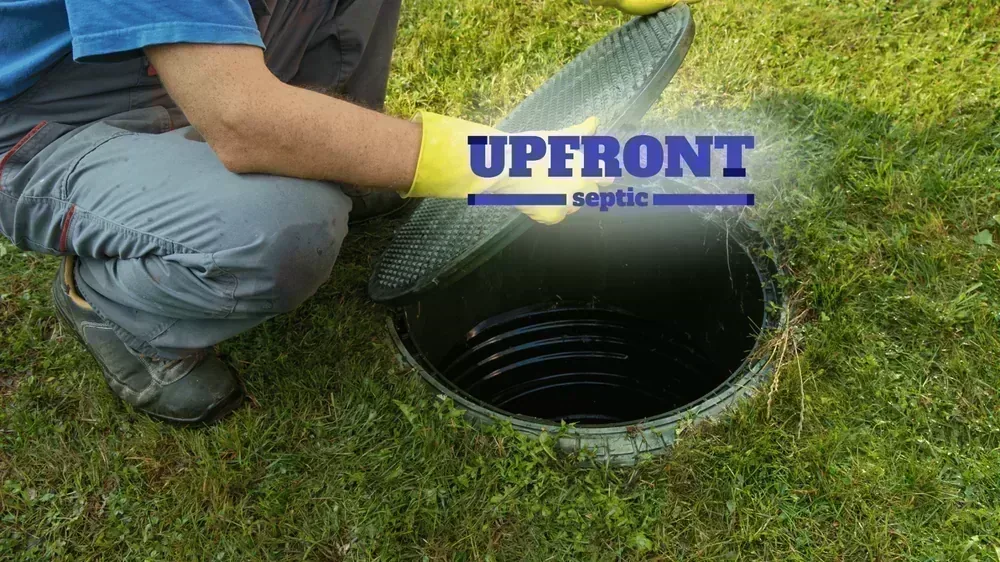
Your septic system quietly handles everyday waste—but when it falters, issues can escalate quickly. Septic inspections Kent WA can uncover plumbing failures, leaks, or septic tank damage before they become costly emergencies. At Upfront Septic, we offer professional inspection services backed by upfront pricing, expert technicians, and reliable septic services.
What Your Septic Inspection Includes
Our septic inspections Kent WA are comprehensive and tailored:
System Mapping & Accessibility
We locate all key components—septic tank lids, risers, distribution box—and ensure easy access, even if your septic system is buried, fenced, or under landscaping.
Structural Evaluation
We systematically inspect the tank for structural damage, including cracks, root intrusion, corrosion, and weakened areas.
Plumbing & Pipe Assessment
We examine inlet/outlet piping, clean-outs, baffles, and joints. Any clogs, damage, or signs of poor flow are documented.
Leak & Level Testing
By observing water levels and using dye flow tests, we detect leaks, standing water, or abnormal flow patterns that could signal failure.
Drain Field Check
We assess the drain field for saturation, pooling liquids, or excessive greenness—warning signs of septic system issues.
Alarm System Verification
If your system has an alarm, float switches, or pumps, we test each component for proper operation.
Findings & Professional Recommendations
After inspection, we provide a clear, written report. It prioritizes any issues and outlines next steps—from minor septic repair to replacement.
Choosing Upfront Septic in Kent
Here’s why Kent homeowners rely on us:
Honest, Local Experience
Founded to challenge national companies that overcharge, Upfront Septic is built on clear, fair pricing and local expertise.
Broad System Knowledge
We service all tank and field types: concrete, fiberglass, plastic, residential septic, commercial septic, aerobic, anaerobic, chamber, mound, drip distribution, sand filters, evapotranspiration—you name it.
Licensed, Certified, Insured
Our technicians are licensed, insured, and trained to follow Washington state standards and environmental regulations.
Clean, Respectful Service
We show up on time, leave your property clean, and clearly communicate steps at every stage.
Emergency Cover 24/7
If a backup, overflow, or home emergency arises, our team is available around the clock to resolve the issue fast.
Inspection vs. Pumping: Understand the Difference
When both are scheduled together, you get a snapshot of performance and clear out waste to prevent backups.
Contact Upfront Septic
Ready for septic inspections Kent WA that are honest, thorough, and hassle-free? Here’s how to get started:
Phone: (253) 364‑7416
We’re here to ensure your septic system serves you—and your family—well into the future.
Septic inspections in Kent, by the records
Every septic inspection in King County is filed with the health department, so what follows is what inspectors actually recorded in Kent rather than a rule of thumb.
| Measure | Figure | What it covers |
|---|
| Inspections filed in Kent, 2015–2025 | 6,148 | Every inspection is filed with the health department |
|---|
| Inspections that found a problem | 24.0% | 0.6 points above the King County average |
|---|
| Carried out at the point of sale | 2,922 | Of which 26.0% found a problem |
|---|
| Partial rather than full inspections | 22.8% | Region-wide, partial inspections find a problem more often |
|---|
| Past due for an inspection | 54.2% | Of the 2,713 whose system type is on record |
|---|
| Past twice their interval | 30.9% | A subset of the row above |
|---|
| Properties on septic in Kent | 4,121 | System type recorded for 2,713 of them (66%) |
|---|
Of the inspections filed in Kent over the decade to 2025, 24.0% recorded a deficiency — 0.6 points above the King County average. A deficiency is an inspection filed with a status of Deficient, and the records carry no severity field, so it covers everything from a missing riser lid to a failed drain field. It is not the same thing as a broken system.
Roughly 48% of the inspections here happened because a property was changing hands, and 26.0% of those found something. Washington requires an inspection at sale whatever the system type, so that group is a complete count of a defined event rather than a sample.
How often you are due depends on what kind of system you have, so this can only be measured where the type is on record. In Kent that is 2,713 of the 4,121 septic properties — 66%. Of those, 54.2% have no inspection filed within their interval and 30.9% are past twice it. The rest cannot be assessed either way, and nothing here should be read as a finding about them.
If you do not know where your own system stands, we can tell you: there is more on what an inspection covers, who is allowed to carry one out and what the records show region-wide on our septic inspections page.
What the rules require in Kent
On-site sewage in King County is governed by Board of Health Title 13, adopted in February 2025 and in effect since 1 April 2025. Inspection frequency comes from Table 13.60-1: a gravity system without a pump is monitored every three years; public-domain technology — mounds, intermittent sand filters and pressure distribution — and proprietary treatment units are monitored every year. A newly installed system gets its first inspection six months after occupancy, or 45 days for a proprietary or commercial system.
King County is unusual in who may do the work. On a gravity system without a pump the owner may perform the routine monitoring themselves, as may a licensed maintainer or a licensed OSS pumper. Anything with a pump, and anything in a marine recovery area, requires a licensed maintainer. The report goes to you at the time of the inspection and to the health officer within thirty days.
Solids have their own separate rule: the owner must determine the level of solids and scum at least every three years for a residential system with no garbage grinder, and every year if a garbage grinder is installed.
Selling a home in Kent triggers its own inspection. Before title transfers the seller must have a property transfer monitoring and performance inspection carried out by a licensed OSM, unless one was performed in the previous twelve months and the property has not changed hands since. The owner must also give the buyer the maintenance records if they have them.
Sources: King County Board of Health Title 13, Sections 13.60.005, 13.60.020 and 13.60.030, and Table 13.60-1. Revised OSS codes · Records search